Wilt Chamberlain: The Dental Visit Before His Heart Attack
What His Story Teaches Us About the Dental Implant Time Bomb
What if one of the greatest athletes who ever lived was telling us something about dentistry that we still aren’t listening to?
Wilt Chamberlain was nearly indestructible.
At 7 feet 1 inch, he was one of the most dominant athletes in history. He scored 100 points in a single NBA game. He played professional basketball for 14 seasons. Even after retirement, he remained extraordinarily active.
But in the final weeks of his life, something changed.
And one of the most important parts of the story happened in a dental chair.
The Week Before Wilt Died
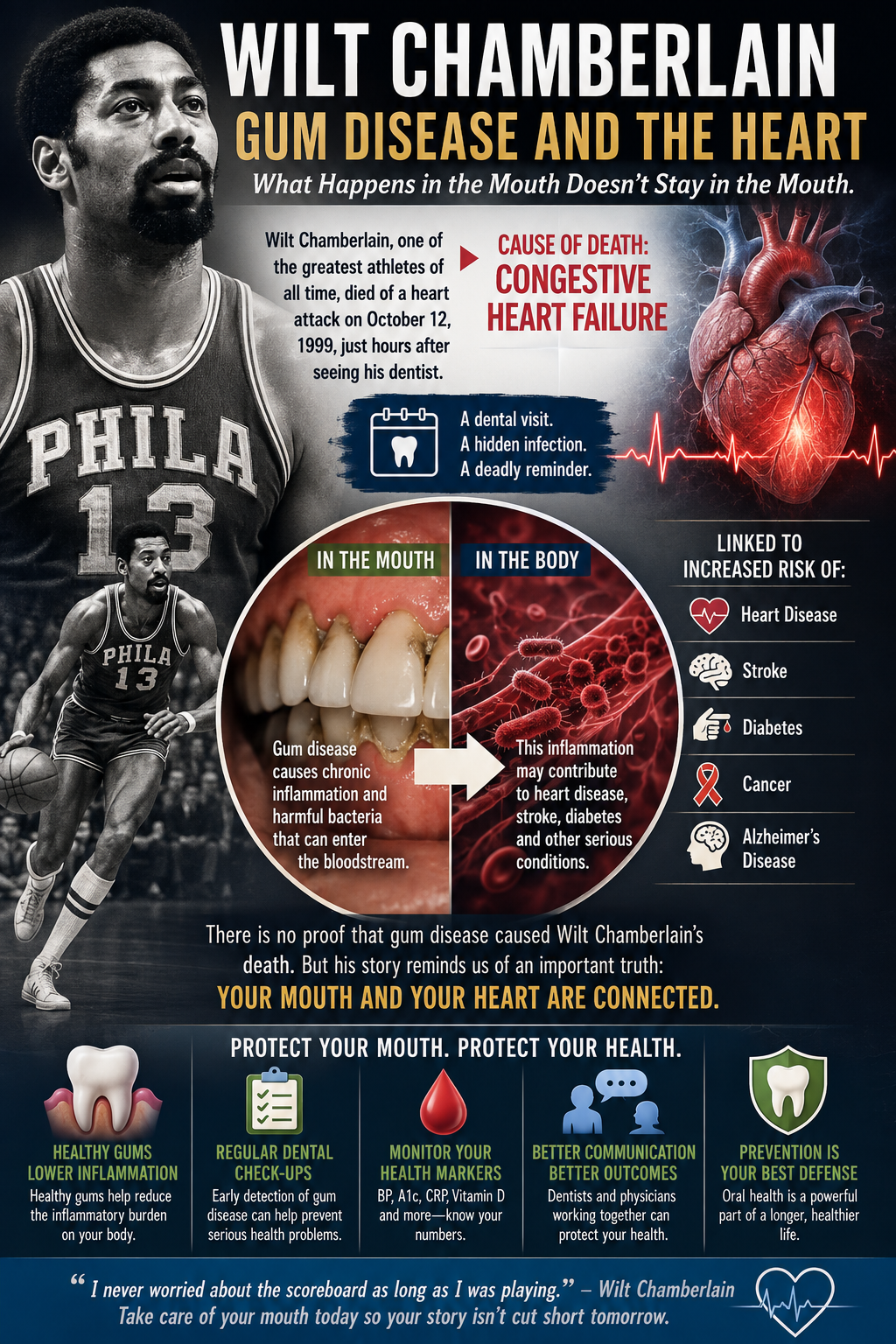
In October 1999, Wilt Chamberlain underwent dental surgery.
According to contemporary reports, the procedure involved removing teeth that had been damaged during his basketball career. His sister said he had lost approximately 50 pounds in the month before his death and that, following the dental surgery, he complained of extraordinary pain—something she said was highly unusual for him.
On October 12, 1999, Wilt Chamberlain died at his Bel-Air home at age 63.
Early reports indicated signs of a possible heart attack.
His longtime attorney and friend, Sy Goldberg, subsequently reported that Chamberlain had congestive heart failure and had deteriorated rapidly in the preceding month.
The timing is impossible to ignore.
But it is equally important not to make a claim the evidence doesn’t support:
There is no established medical evidence that the dental surgery caused Chamberlain’s death.
So why does his story matter?
Because it raises a question every dentist, physician and patient should be asking:
What happens when a patient has a serious systemic health problem—and we only look at the mouth?
The Dental Implant Time Bomb
This is where the story becomes particularly relevant today.
Dental implants have transformed dentistry.
They can restore function, improve chewing, preserve appearance and dramatically improve quality of life.
But an implant is not a tooth.
It is a foreign structure placed into living tissue and surrounded by bone, connective tissue and microorganisms.
And once an implant is placed, the patient has entered a new biological relationship with that implant.
That’s why the Meditz Method™ asks a question that traditional implant dentistry often doesn’t ask deeply enough:
Is this patient biologically ready for an implant?
Not simply:
Can we place the implant?
But:
Should we place the implant—and what is happening in the patient’s mouth and body that could determine whether it remains healthy?
The Implant Doesn’t Create the Problem
The real danger may begin long before the implant is placed.
Consider the patient with:
- A history of periodontal disease
- Chronic gum inflammation
- Bone loss
- Poor oral hygiene
- Diabetes or elevated A1c
- Elevated inflammatory markers
- Vitamin D insufficiency
- Smoking history
- Cardiovascular disease
- Poorly controlled systemic inflammation
The missing tooth may be the most obvious problem.
But it may not be the most important problem.
The biological environment surrounding the implant may determine whether that implant remains healthy for years—or becomes another site of chronic inflammation.
That’s the concept behind what I call the:
Dental Implant Time Bomb™
The implant can look perfectly healthy today.
The patient can feel perfectly healthy today.
The X-ray can look acceptable today.
And yet the biological conditions necessary for long-term implant health may not be present.
The Question We Should Ask Before Implant Surgery
Traditional implant planning often focuses on:
Bone + Implant + Crown
The Meditz Method™ looks at the bigger picture:
Patient + Inflammation + Bone + Microbiome + Systemic Health + Implant
That changes everything.
Before placing an implant, why wouldn’t we want to know:
What is happening with the patient’s periodontal health?
What is happening with systemic inflammation?
Is blood sugar controlled?
What is the patient’s blood pressure?
What is their cardiovascular history?
What is their Vitamin D status?
What is their inflammatory burden?
What is happening in the rest of the mouth?
Because an implant doesn’t exist in isolation.
It exists inside a human being.
Wilt’s Story Gives Us a Warning
Wilt Chamberlain’s story is not proof that dental surgery caused his heart failure.
It isn’t proof that periodontal disease caused his death.
And it would be irresponsible to suggest otherwise.
But his story does demonstrate something we should take seriously:
A patient can have significant cardiovascular disease while simultaneously undergoing significant dental problems and treatment.
In Chamberlain’s case, contemporary reporting documented both.
He had a history of cardiac problems, had experienced a recent decline in health, underwent dental surgery shortly before his death, experienced severe pain afterward, and then died from heart failure.
The lesson isn’t to fear the dentist.
The lesson is to connect the dots.
Dentistry Has an Opportunity Medicine Doesn’t Always Have
Think about it.
Your dental team can see:
The gums.
The bone.
The teeth.
The tongue.
The oral microbiome.
Signs of chronic inflammation.
Evidence of infection.
And, increasingly, dentistry can incorporate information about:
Blood pressure.
A1c.
CRP.
Vitamin D.
Medications.
Medical history.
That’s an extraordinary amount of information.
Yet too often the dental appointment still ends with:
“See you in six months.”
What if the question became:
“What is your mouth telling us about your health?”
The Mouth Is the Gateway
Periodontal disease isn’t simply about losing teeth.
The tissues surrounding your teeth are living tissues.
When disease develops, bacteria and inflammatory mediators interact with the body’s immune system.
That is why periodontal disease has been studied in relation to systemic inflammatory and cardiovascular conditions.
It doesn’t mean every heart attack begins in the mouth.
It doesn’t mean every implant patient will develop systemic disease.
And it certainly doesn’t mean that a dental procedure causes heart attacks.
But it does mean we should stop pretending the mouth exists in a separate biological universe.
It doesn’t.
The mouth is part of the body.
The Real Dental Implant Time Bomb
The time bomb isn’t necessarily the tooth or implant.
The time bomb is the biology we fail to identify before we place it.
A patient can have an implant placed into an environment that is already fighting inflammation.
A patient can have untreated periodontal disease.
A patient can have compromised bone.
A patient can have uncontrolled metabolic disease.
A patient can have systemic inflammatory problems.
And then we wonder why the implant eventually develops complications.
Perhaps we should have asked better questions before we placed it.
The Meditz Method™ Changes the Conversation
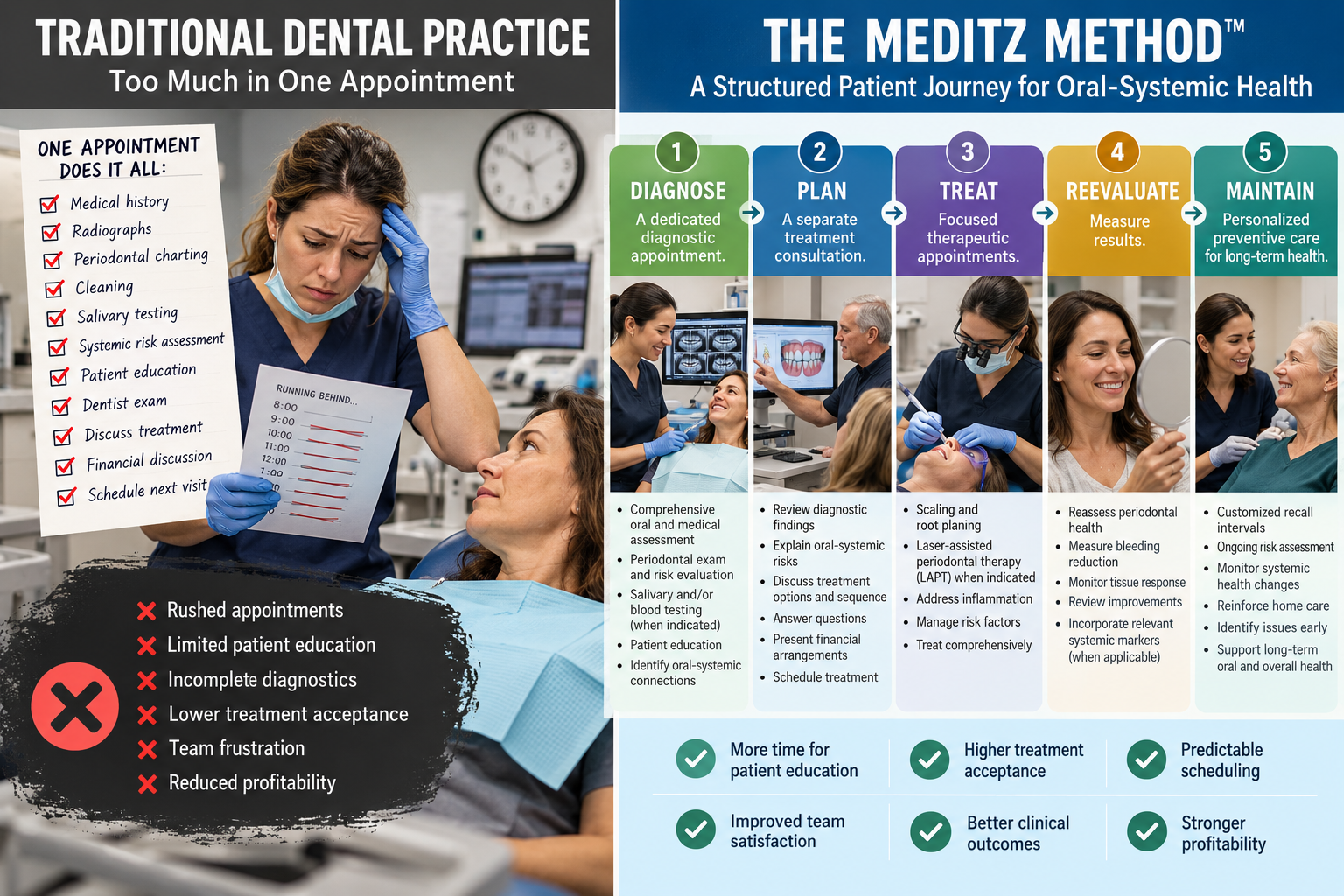
The Meditz Method™ is built around a simple principle:
Don’t just treat the tooth. Treat the patient.
That means identifying oral disease.
Reducing pathogenic bacterial burden.
Addressing inflammation.
Evaluating the patient’s systemic health.
Improving the biological environment.
And coordinating care when the patient’s health extends beyond the dental office.
Because the goal isn’t simply:
“How do we save this tooth?”
Or even:
“How do we place this implant?”
The bigger question is:
“How do we protect this patient’s health while we restore their mouth?”
Wilt Chamberlain Was a Giant
Wilt Chamberlain spent his life proving that extraordinary physical strength doesn’t make someone invincible.
His story ended at only 63.
And the details surrounding his final weeks—including his cardiovascular history, rapid health deterioration and dental surgery—should make every dental professional pause and think.
Not because we can rewrite his medical history.
Not because we can claim to know exactly what happened.
But because we can learn from it.
The next patient sitting in your dental chair may not simply need an implant.
They may need a health assessment.
They may need better periodontal treatment.
They may need medical collaboration.
They may need their inflammation addressed.
And they may need someone to recognize that the problem isn’t just what’s missing from their smile.
It’s what may be happening underneath it.
Don’t Let the Implant Become the Time Bomb
Before the next implant is placed, ask more questions.
Look beyond the tooth.
Look beyond the X-ray.
Look beyond the bone.
Look beyond the implant.
Look at the patient.
Because the greatest advancement in implant dentistry may not be another implant design.
It may be learning how to identify the patient who isn’t biologically ready for one.
That’s the Meditz Method™.
Diffuse the Dental Implant Time Bomb™.
Because the best implant is not simply the one that looks good on the day it’s placed.
It’s the one that remains healthy years later.