Why Doesn’t Dental Insurance Cover Everything? Understanding the Four Levels of Dental Care
Your dental insurance may help pay for treatment—but it doesn’t necessarily cover everything you need to achieve optimal oral and whole-body health.
Have you ever wondered why your dentist recommends a treatment that your insurance company won’t cover?
Or why two dentists can examine the same patient and recommend completely different treatment plans?
The answer may surprise you.
Dental insurance, dental care, and comprehensive oral-systemic health are not the same thing.
Understanding the difference can help you make better decisions about your teeth, gums, implants, and long-term health.
Dental Insurance Is a Financial Benefit, Not a Complete Health Plan
Most dental insurance plans are designed to help pay for certain dental services within specific financial limits.
Coverage is determined by the terms of your policy, including annual maximums, deductibles, waiting periods, frequency limits, exclusions, and negotiated fees.
That means a treatment can be clinically appropriate—even important—without being fully covered.
For example, your dentist may recommend additional periodontal diagnostics, advanced gum therapy, or a more comprehensive evaluation of your oral health. Your insurance plan may cover only part of those services, or none at all.
A denial of insurance coverage does not automatically mean the treatment is unnecessary.
Likewise, having insurance coverage does not automatically mean a procedure is the best choice for your individual needs.
The important question is not simply, “Will my insurance pay for it?”
It is, “What care do I need, why do I need it, and what could happen if I delay?”
The Four Levels of Dental Care: Why All Dentists Are Not Alike
Dentists complete extensive professional education and must meet licensing requirements. However, their practice philosophies, diagnostic approaches, clinical training, technology, and treatment protocols can differ considerably.
One way to understand these differences is through four levels of care.
These are educational categories—not official dental specialties or rankings. A dentist may provide services across several levels.
Level 1: Problem-Focused Dentistry
Primary focus: Fix the immediate problem.
At this level, care concentrates on identifying and treating existing dental problems.
Common services include:
- Fillings for cavities
- Extractions
- Crowns and restorations
- Emergency dental treatment
- Routine cleanings and examinations
This care is essential. Relieving pain, eliminating infection, and restoring damaged teeth are important parts of dentistry.
However, treating the immediate problem may not fully address why it developed.
For example, replacing a broken tooth without investigating bite forces, periodontal disease, or other contributing factors may leave underlying risks unresolved.
Key question: Are we fixing the problem, or also identifying what caused it?
Level 2: Preventive and Maintenance Dentistry
Primary focus: Help prevent future dental problems.
This level emphasizes regular examinations, professional cleanings, preventive services, and monitoring changes over time.
Care may include:
- Periodontal measurements and examinations
- Dental X-rays when appropriate
- Caries-risk assessments
- Fluoride or other preventive therapies
- Personalized brushing and interdental cleaning instructions
- Periodontal maintenance for patients with a history of gum disease
This approach can reduce preventable dental problems and help detect disease earlier.
But prevention should be individualized.
A patient with a history of periodontal disease, poorly controlled diabetes, or recurrent inflammation may need more than a standard six-month cleaning schedule.
Key question: Is my preventive care designed around my individual risk factors?
Level 3: Advanced Diagnostic and Therapeutic Dentistry
Primary focus: Identify underlying risks and treat disease more comprehensively.
At this level, dentists may incorporate additional diagnostic tools, specialized periodontal therapies, and more detailed treatment planning.
Depending on the patient’s needs and the clinician’s training, services may include:
- Comprehensive periodontal and implant assessments
- Salivary testing when clinically appropriate
- Evaluation of contributing factors such as dry mouth, smoking, medications, and diabetes
- Advanced periodontal treatment
- Laser-assisted periodontal therapy when indicated
- Occlusal and functional assessments
- Closer monitoring of treatment outcomes
The objective is to go beyond repeatedly treating symptoms and better understand why problems recur.
For example, a patient with persistent bleeding gums may need a comprehensive periodontal evaluation and individualized treatment—not simply another routine cleaning.
Some advanced technologies and tests have stronger evidence for specific uses than others. They should be selected based on demonstrated clinical benefit, not technology alone.
Key question: Are we identifying and addressing the factors that keep my disease returning?
Level 4: Comprehensive Oral-Systemic Health Dentistry
Primary focus: Integrate oral health with the patient’s overall health.
This is the approach emphasized by The Meditz Method™.
Research increasingly recognizes important relationships between oral conditions, particularly periodontal inflammation, and systemic health.
Periodontal disease is associated with conditions such as diabetes and cardiovascular disease. These relationships do not mean every oral infection causes systemic disease, but they reinforce the importance of understanding the mouth as part of the whole person.
A comprehensive oral-systemic approach may include:
- Detailed medical and dental health histories
- Comprehensive periodontal and implant risk evaluations
- Assessment of oral inflammation and contributing factors
- Coordination with physicians when medical conditions affect dental treatment
- Review of relevant medical information, such as A1c results for patients with diabetes
- Individualized periodontal and restorative treatment plans
- Personalized home-care protocols
- Ongoing reassessment and maintenance
For certain patients, a medical professional may also recommend evaluating markers such as C-reactive protein, A1c and vitamin D. These tests are not universally indicated dental screening tools, and their interpretation should occur in the appropriate medical context.
The goal is not to turn the dentist into a physician.
It is to help dental and medical professionals work together so important health risks are not overlooked.
Key question: Is my dental team considering how my oral health and medical health may affect each other?
How the Four Levels Compare
| Level | Primary objective | Patient benefit |
|---|---|---|
| 1. Problem-Focused | Repair damage and relieve symptoms | Restore function and comfort |
| 2. Preventive | Reduce future dental problems | Maintain healthier teeth and gums |
| 3. Advanced Therapeutic | Investigate risks and manage complex disease | More individualized disease management |
| 4. Oral-Systemic | Coordinate oral care with overall health | Comprehensive, collaborative prevention and treatment |
These levels are not mutually exclusive. A comprehensive dentist still performs fillings, cleanings, and restorative care. The difference is the breadth of evaluation and how treatment decisions are integrated.
Why Insurance Doesn’t Always Keep Up With Comprehensive Care
Dental insurance plans differ significantly, but several common limitations can create gaps between recommended care and covered services.
1. Annual benefit maximums
Many plans limit how much they will pay each year. Complex periodontal, restorative, or implant treatment may exceed that maximum.
2. Frequency restrictions
A plan may limit how often it pays for examinations, imaging, or certain preventive services—even when a patient needs additional monitoring.
3. Excluded or limited procedures
Some diagnostic tests, advanced therapies, and implant-related services may be excluded or subject to special conditions.
4. Medical and dental coverage are often separate
A patient’s periodontal condition may be relevant to diabetes management, yet dental and medical benefits are typically administered separately.
5. Coverage decisions are not individualized treatment plans
Insurance policies apply contractual rules. Your dentist’s responsibility is to recommend clinically appropriate care based on your examination, diagnosis, health history, and treatment goals.
Not every additional service is necessary, and more expensive care is not automatically better. The recommendation should be supported by clear clinical findings and a reasonable explanation of its benefits, risks, and alternatives.
The Meditz Method™: Separating Diagnosis From Treatment
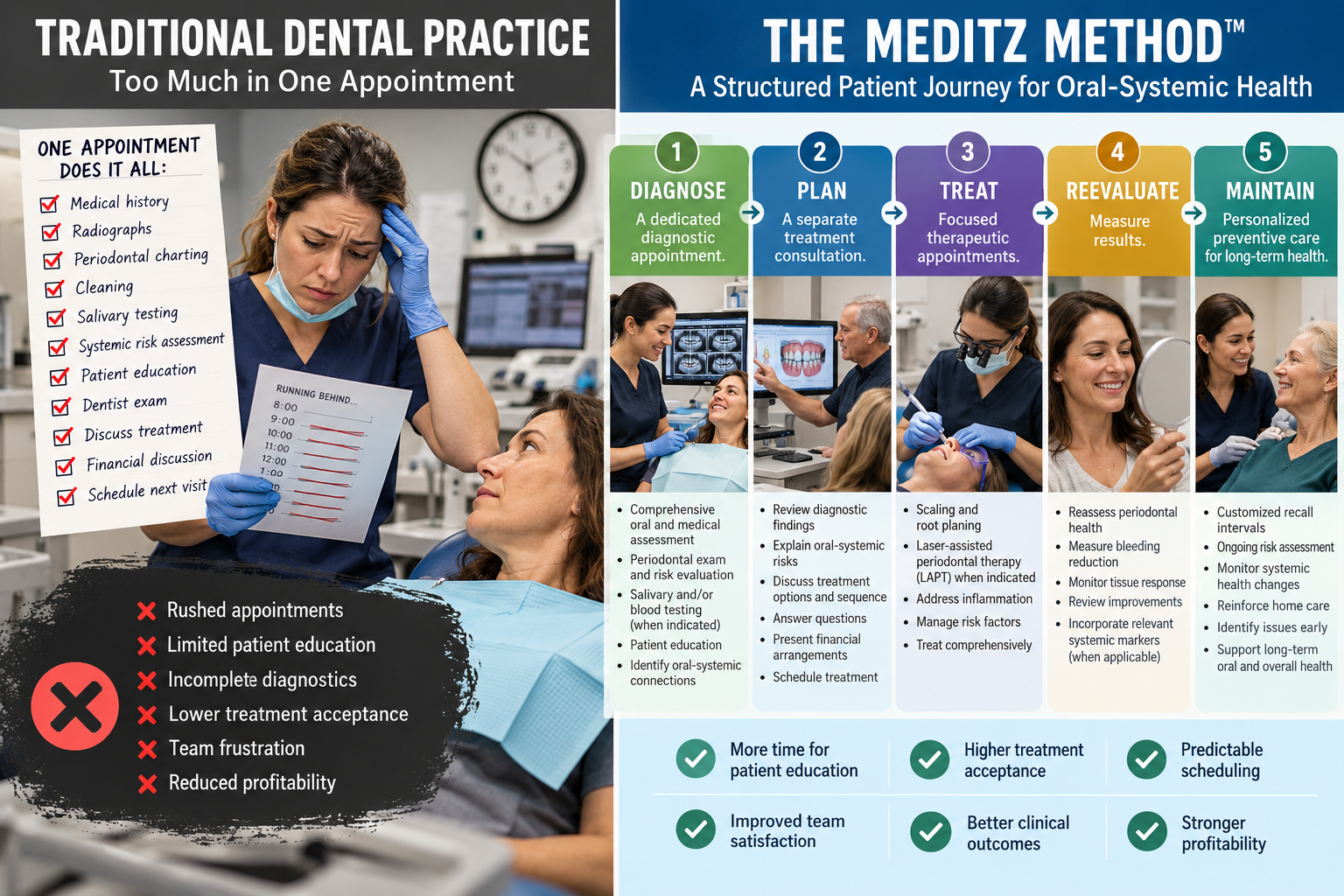
One important principle of The Meditz Method™ is creating a practice structure that gives patients time to understand their health before making major treatment decisions.
Traditional dental appointments often combine examination, diagnosis, treatment recommendations, and scheduling into a single visit.
That can leave patients feeling overwhelmed, especially when the recommended care is extensive or not fully covered by insurance.
The Meditz Method™ encourages a more deliberate process.
Appointment One: Comprehensive Diagnostics
The dental team gathers relevant information, evaluates oral conditions and risk factors, reviews medical history, and identifies areas requiring further investigation.
Appointment Two: Findings, Education, and Treatment Planning
The patient receives a clear explanation of the findings, recommended treatment, alternatives, expected outcomes, financial considerations, and appropriate follow-up.
Separating these steps when warranted creates time for thoughtful decisions.
It can also help the dental team explain which services are covered, which are not, and why the recommended care matters.
Patients should understand their treatment before they are asked to accept it.
Seven Questions to Ask Your Dentist Before Declining Uncovered Treatment
- What specific condition or risk did you identify?
- What diagnostic findings support your recommendation?
- What happens if I postpone this treatment?
- Are there alternative treatments, and how do they compare?
- Is this treatment supported by clinical evidence for my condition?
- Could my medical history affect the treatment or its outcome?
- What will insurance cover, and what will I be responsible for paying?
A dentist who practices comprehensive care should welcome informed questions.
Don’t Let Insurance Alone Determine Your Health Decisions
Dental insurance can be a valuable financial resource. Use the benefits available to you.
But remember that your policy was not written specifically for your mouth, your medical history, your risk factors, or your long-term goals.
The least expensive treatment today may not always provide the best long-term value. At the same time, an uncovered treatment should never be accepted without understanding its clinical justification.
Choose your dental care based on a clear diagnosis, sound evidence, your personal health needs, and informed decisions—not insurance coverage alone.
The Bottom Line
All licensed dentists are qualified to provide care within their training and scope of practice. But not every dental practice offers the same depth of diagnostics, prevention, advanced therapy, or medical-dental collaboration.
Understanding the four levels of dental care can help you recognize what your dental practice offers—and what additional services or coordination might benefit you.
Your insurance policy determines your benefits. Your dental and healthcare professionals help determine your clinical needs. You make the informed decision.
Discover The Meditz Method™
The Meditz Method™ helps dental professionals build a more comprehensive approach to oral-systemic health through diagnostics, patient education, coordinated treatment planning, and ongoing prevention.
Learn more at https://themeditzmethod.com
Explore the book Diffuse the Dental Implant Time Bomb: Reduce the Risk of Heart Attack, Stroke, Cancer, Diabetes, and Alzheimer’s to learn why protecting your teeth, gums, and implants deserves a whole-body perspective.
Educational disclaimer: This article provides general information, not individual dental, medical, or insurance advice. Coverage depends on the specific policy, and clinical decisions should be made with qualified healthcare professionals.