What if protecting your brain health begins with something you do every morning and every night—taking care of your mouth?
For decades, dentistry and medicine have often treated the mouth and the rest of the body as separate systems.
But science is telling us something different.
The mouth is not isolated from the brain, heart, blood vessels, immune system, or metabolic system. It is an active biological environment containing hundreds of species of microorganisms and a highly responsive immune system.
When that environment becomes chronically inflamed—particularly through periodontal disease—the effects may extend far beyond the gums.
One of the most important emerging areas of research is the connection between periodontal disease, chronic inflammation, cognitive decline, dementia, and Alzheimer’s disease.
The connection deserves our attention.
The Oral–Brain Axis
Researchers increasingly refer to the oral–brain axis to describe the potential communication between the oral cavity and the brain.
This connection may occur through several pathways:
- The bloodstream
- The immune system
- Systemic inflammatory signaling
- Microbial products and bacterial toxins
- The blood-brain barrier
- Neural pathways, including the trigeminal system
When periodontal disease is present, the gums can become a chronic source of inflammation and microbial exposure.
Periodontitis is not simply a problem of bleeding gums or loose teeth. It is a chronic inflammatory disease involving the tissues and bone supporting the teeth.
And chronic inflammation is increasingly recognized as an important component of neurodegenerative disease.
Recent reviews have found an association between periodontal disease and Alzheimer’s disease, with several systematic reviews reporting increased risk among people with periodontal disease.
But there is an important distinction:
Association does not prove causation.
We cannot yet say that periodontal disease causes Alzheimer’s disease. What we can say is that the relationship is biologically plausible, increasingly documented, and important enough that oral health should be part of the conversation about healthy brain aging.
What Happens When the Mouth Stays Inflamed?
A healthy mouth maintains a balanced microbial ecosystem.
Problems can develop when that balance—sometimes called oral microbial homeostasis—is disrupted.
Certain disease-associated organisms can increase, the inflammatory response can become excessive, and periodontal tissues can begin to break down.
The result is a chronic inflammatory environment.
Inflammatory molecules and bacterial components can enter the circulation. Researchers are investigating whether this repeated systemic inflammatory burden may contribute to processes involved in neuroinflammation and neurodegeneration.
This is where the mouth and brain connection becomes particularly interesting.
The Inflammation Connection
Alzheimer’s disease is associated with complex changes in the brain, including accumulation of amyloid-beta, abnormal tau protein, immune activation, and neuroinflammation.
Researchers are investigating whether chronic inflammation originating outside the brain can contribute to or amplify these processes.
Periodontal disease is one potential source of that inflammatory burden.
In other words:
Chronic inflammation in the mouth may not stay in the mouth.
The inflammatory signals generated by periodontal disease may contribute to a systemic environment that affects multiple organs—including the brain.
A recent review proposed a mechanistic framework in which oral dysbiosis may contribute to systemic inflammation and activation of brain immune cells called microglia, potentially contributing to Alzheimer’s-related pathology. This remains an active area of research rather than a proven cause-and-effect pathway.
What About the Bacteria?
One organism receiving considerable attention is Porphyromonas gingivalis, a bacterium strongly associated with periodontitis.
Researchers have reported periodontal bacteria and bacterial components in brain tissue from people with Alzheimer’s disease, and laboratory studies have investigated whether bacterial virulence factors can influence neuroinflammation, amyloid-beta, and tau-related processes.
This does not mean that finding a particular oral bacterium means someone will develop Alzheimer’s.
The oral microbiome is enormously complex, and many of these organisms can exist in healthy mouths.
The important issue may be the combination of:
microbial imbalance + chronic inflammation + individual susceptibility + systemic health factors.
That is why simply asking, “What bacteria are in your mouth?” may not be enough.
We also need to ask:
What is your mouth doing to your immune system?
Tooth Loss May Be Another Piece of the Puzzle
Tooth loss is another factor being investigated in relation to cognitive decline.
Periodontal disease is one of the major causes of tooth loss in adults. At the same time, tooth loss can affect chewing ability, nutrition, speech, social interaction, and quality of life.
Recent evidence consistently finds an association between poor oral health, tooth loss, and worse cognitive outcomes. However, researchers are still working to determine how much of this relationship is biological, behavioral, nutritional, or related to shared risk factors.
This raises an important question:
Could maintaining your natural teeth and maintaining a healthy periodontal environment be part of protecting healthy brain aging?
It is a question worth taking seriously.
The Relationship May Work Both Ways
There is another side to the story.
As cognitive impairment develops, a person may gradually lose the ability to maintain good oral hygiene.
They may:
- Forget to brush or floss
- Miss dental appointments
- Have difficulty using a toothbrush
- Forget medications
- Experience changes in diet
- Develop dry mouth
- Have difficulty recognizing oral discomfort
- Become dependent upon caregivers for oral hygiene
This can allow plaque and inflammation to increase.
So the relationship may be bidirectional.
Poor oral health may contribute to processes associated with cognitive decline, while cognitive decline can make maintaining oral health increasingly difficult.
That creates a potentially dangerous cycle:
Oral inflammation → systemic inflammation → possible neuroinflammatory burden → cognitive decline → reduced oral self-care → worsening oral inflammation
Breaking that cycle early may be an important component of healthy aging.
Could Oral Health Be an Early Warning System?
This is where oral-systemic dentistry can offer a different perspective.
Rather than waiting until a patient has significant tooth loss, severe periodontal destruction, or obvious cognitive impairment, we should pay attention to the early signs of inflammation.
Bleeding gums are not simply a cosmetic problem.
Persistent gum inflammation may be a signal that the body’s inflammatory and microbial balance is not where it should be.
Other factors worth evaluating include:
- Periodontal pocketing
- Bone loss
- Bleeding on probing
- Tooth mobility
- Tooth loss
- Oral microbiome balance
- Chronic oral infections
- Blood pressure
- A1c and metabolic health
- Vitamin D status
- Inflammatory markers such as CRP
- Nutrition
- Sleep
- Lifestyle factors
- Family and medical history
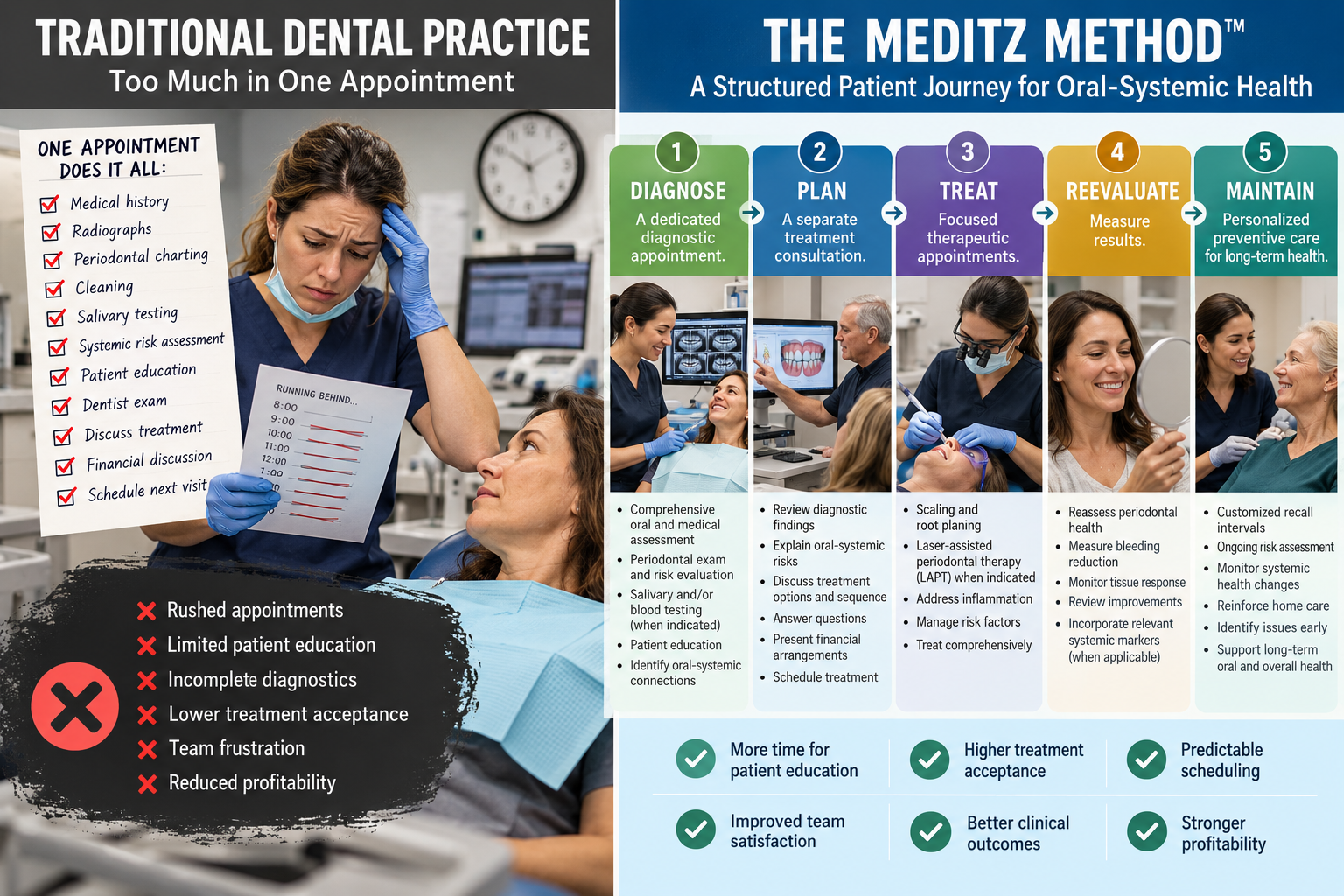
This is the philosophy behind The Meditz Method™:
Don’t simply treat the teeth. Look at the person behind the teeth.
The Mouth Is Part of the Whole-Body Picture
The goal is not to claim that treating periodontal disease will prevent Alzheimer’s disease.
We don’t have enough evidence to make that claim.
The goal is much more practical:
Identify and reduce preventable sources of chronic oral inflammation while supporting overall health.
If periodontal disease is associated with increased risk of cognitive decline, then controlling periodontal inflammation becomes one more potentially modifiable component of a comprehensive healthy-aging strategy.
And even if future research ultimately shows that periodontal disease is only one piece of a much larger puzzle, maintaining a healthy mouth still provides enormous benefits.
Healthy gums.
Better chewing function.
Preservation of natural teeth.
Better nutrition.
Reduced oral infection.
Improved quality of life.
And potentially, a healthier inflammatory environment.
What Should We Do Differently?
The traditional approach has often been:
“Come to the dentist when something hurts.”
The oral-systemic approach is different.
It asks:
“What can we identify and address before disease becomes destructive?”
That means dentists, hygienists, physicians, and patients need to communicate.
It means periodontal disease should be recognized as a chronic inflammatory condition—not merely a dental problem.
It means patients should understand that bleeding gums are not necessarily “normal.”
And it means we should begin thinking about oral health as part of brain health, cardiovascular health, metabolic health, and whole-body health.
Your Brain and Your Mouth Are Not Separate
We cannot choose our genetics.
We cannot eliminate every risk factor for Alzheimer’s disease.
And we cannot promise that excellent oral health will prevent dementia.
But we can address what we can control.
We can monitor periodontal health.
We can reduce chronic oral inflammation.
We can support a healthy oral microbiome.
We can preserve natural teeth whenever possible.
We can monitor systemic markers.
We can improve nutrition and home care.
And we can recognize that the mouth is an important part of the body’s overall inflammatory and immune environment.
The emerging science of the oral–brain axis gives us another reason to take periodontal health seriously.
Don’t wait for your brain to tell you something is wrong.
Listen to your mouth first.
Because the future of healthcare may depend on recognizing what dentistry has been seeing for years:
The mouth is not separate from the body.
The mouth is part of the body—and potentially part of the brain-health conversation.
The Meditz Method™: Connecting Oral Health to Whole-Body Health
The Meditz Method™ takes an integrated approach to oral-systemic health by combining periodontal assessment, inflammation awareness, advanced periodontal therapies, diagnostics, medical collaboration, and personalized home care.
Its guiding principle is simple:
Don’t just treat the disease you can see. Look for the silent threats that may be affecting the rest of the body.