For decades, dentistry has primarily focused on one question:
“What is happening in the mouth?”
But a new question is changing the way forward-thinking dental professionals practice:
“What is happening in the mouth—and what could it be telling us about the rest of the body?”
The growing field of oral-systemic health recognizes that the mouth does not operate independently from the heart, brain, immune system, metabolic system, and overall health.
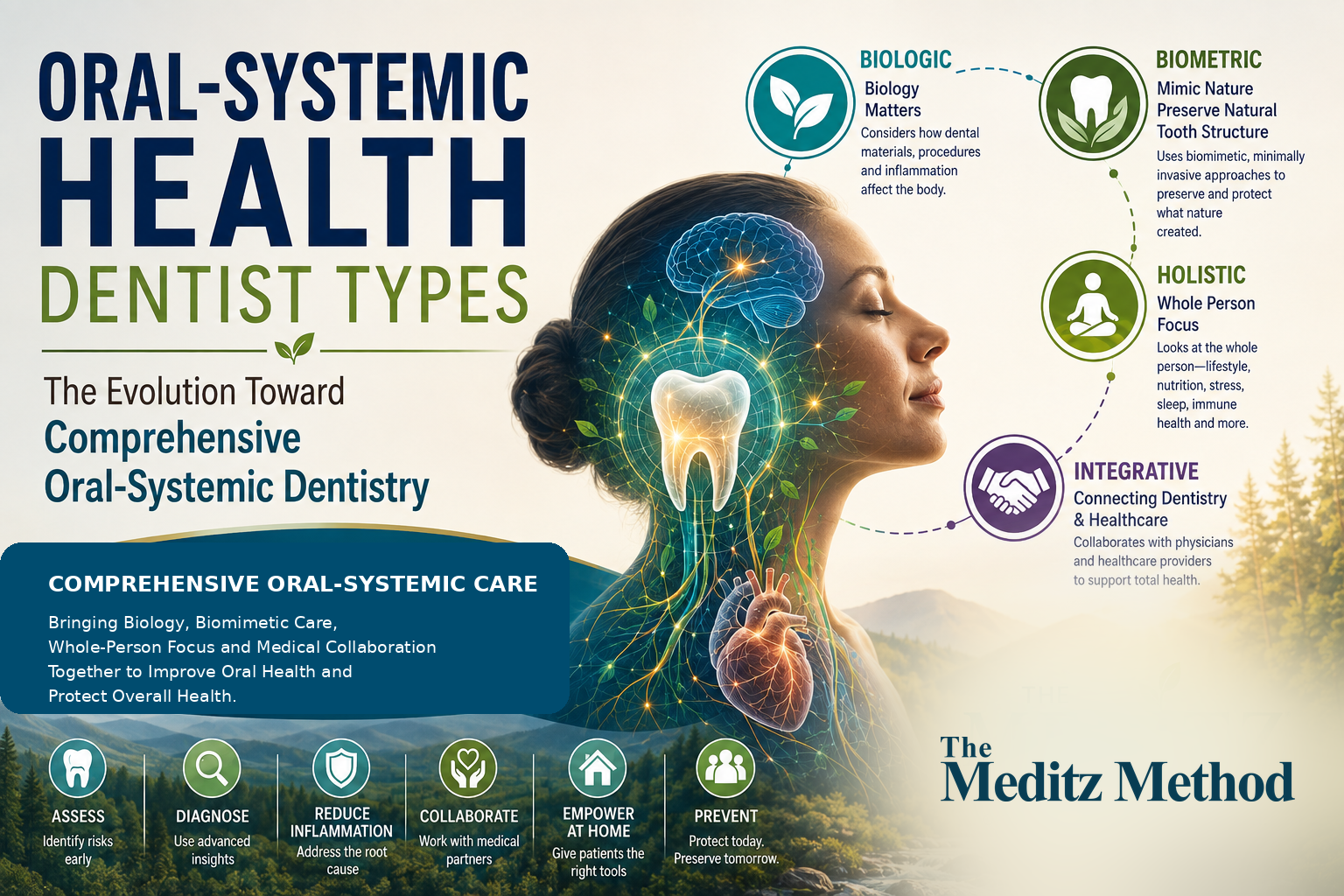
As dentistry evolves, several different approaches have emerged. You may hear dentists describe themselves as biologic, biometric, holistic, or integrative.
While these terms can overlap, each represents a different step toward looking at the patient as more than a set of teeth.
And this is where The Meditz Method™ takes the conversation further.
The Four Types of Oral-Systemic Health Dentists
1. The Biologic Dentist
A biologic dentist generally looks beyond traditional dentistry and considers how dental materials, procedures, inflammation, and oral conditions may affect the body’s biological systems.
The biologic approach often asks:
- Are the materials we use compatible with the patient’s biology?
- Could chronic oral inflammation be affecting overall health?
- Are there less invasive or more biologically conservative treatment options?
- How can we reduce unnecessary exposure to potentially problematic materials?
This represents an important shift.
Instead of viewing the mouth as an isolated mechanical system, the biologic dentist recognizes that everything placed or done in the mouth exists within a living biological system.
But there is still another question:
How can we preserve the body’s natural design while treating disease?
That brings us to the biometric approach.
2. The Biometric Dentist
A biometric approach emphasizes mimicking nature by preserving tooth structure.
Rather than relying on aggressive preparation, extensive removal of healthy enamel, or restorations that replace more tooth structure than necessary, the biometric dentist seeks to understand and respect the natural architecture, function, and biology of the tooth.
The biometric approach often asks:
- How much healthy tooth structure can we preserve?
- Can treatment imitate the tooth’s natural form and function?
- Can we intervene earlier and more conservatively?
- Can we strengthen, repair, or restore the tooth without unnecessarily sacrificing healthy structure?
- How can we design treatment around the way teeth naturally absorb, distribute, and respond to forces?
This may involve careful diagnosis, magnification, digital imaging, minimally invasive preparation, adhesive techniques, biomimetic materials, and restorations designed to work with the remaining natural tooth.
The philosophy is simple:
The best restoration is often the tooth structure we never remove.
Biometric dentistry recognizes that natural teeth are not merely hard objects to be repaired. They are living, dynamic structures with a complex relationship between enamel, dentin, pulp, periodontal tissues, occlusion, and the surrounding oral environment.
By preserving more of the natural tooth, the practitioner may help maintain structural strength, natural biomechanics, sensory feedback, pulp vitality, long-term restorability, resistance to fracture, and the tooth’s ability to function as part of the larger system.
This represents a major shift from simply replacing damaged tooth structure to working with the tooth’s natural design.
Biometric dentistry is therefore not primarily about measuring the body. It is about using nature as the model for diagnosis, prevention, preparation, restoration, and long-term care.
But preserving tooth structure is only one part of understanding the whole patient.
That brings us to the holistic approach.
3. The Holistic Dentist
Holistic dentistry takes an even broader view.
The word holistic comes from the concept of looking at the whole person rather than focusing on a single part.
A holistic dental philosophy may consider nutrition, lifestyle, stress, sleep, breathing, immune health, inflammation, the oral microbiome, environmental factors, dental materials, and the relationship between oral and systemic health.
The underlying philosophy is powerful:
The patient is more than a mouth.
However, holistic dentistry can mean different things to different practitioners.
Some approaches emphasize natural therapies. Others focus on lifestyle. Others emphasize minimally invasive dentistry, preserving natural tooth structure, or reducing exposure to certain materials.
The opportunity—and the challenge—is bringing these concepts into a consistent, measurable clinical process.
That leads to the fourth category.
4. The Integrative Dentist
An integrative dentist attempts to connect dentistry with the broader healthcare system.
Rather than operating in a silo, the integrative dentist recognizes that dental health can intersect with cardiovascular health, diabetes and metabolic health, inflammation, brain health, immune function, sleep, nutrition, and other medical conditions.
The integrative approach can involve communication and collaboration with physicians and other healthcare professionals.
This represents an important evolution:
Dentistry becomes part of healthcare rather than operating separately from it.
But there is still a missing piece.
How do we turn all of these ideas into a repeatable system inside a dental practice?
This Is Where The Meditz Method™ Fits
The Meditz Method™ was developed around a simple premise:
The mouth should not be treated separately from the person it belongs to.
It brings together the strengths of biologic, biometric, holistic, and integrative thinking and turns them into a practical oral-systemic health approach.
Instead of choosing between these philosophies, The Meditz Method™ asks:
Why not bring the best elements of each into one comprehensive patient-centered system?
Biologic thinking asks:
“How does what we do in the mouth affect the biology?”
Biometric thinking asks:
“How can we mimic nature and preserve as much natural tooth structure as possible?”
Holistic thinking asks:
“What is happening with the whole person?”
Integrative thinking asks:
“How do we connect dentistry with the rest of healthcare?”
The Meditz Method™ asks:
“How do we put all of this together into a practical system for prevention, diagnosis, treatment, collaboration, and long-term health?”
From Treating Teeth to Managing Risk
Traditional dentistry has been remarkably successful at treating problems once they appear.
A cavity is restored.
A tooth is extracted.
A periodontal pocket is treated.
A tooth is replaced.
An implant is placed.
But oral-systemic dentistry introduces another level of thinking:
What caused the problem in the first place?
And perhaps even more importantly:
What can we identify before the problem becomes irreversible?
This changes the role of the dental professional.
The dental practice can become an important point of health-risk identification and prevention.
A periodontal examination isn’t simply about measuring pocket depths. It can become an opportunity to identify inflammation.
A discussion about bleeding gums isn’t simply about brushing technique. It can become a conversation about the patient’s inflammatory burden.
A discussion about a cavity isn’t simply about placing a filling. It can become a conversation about how to preserve the remaining natural tooth structure, restore function, and reduce the risk of future breakdown.
A discussion about an implant isn’t simply about replacing a missing tooth. It can become a conversation about the patient’s long-term oral environment, periodontal history, inflammation, bone health, and maintenance.
And a routine dental visit can become an opportunity to identify information that may be valuable to the patient’s medical team.
The Mouth as an Early Warning System
One of the most exciting possibilities in oral-systemic health is the concept of the mouth as an early warning system.
The oral cavity is accessible.
It can be examined regularly.
Changes can be documented.
Inflammation can be measured.
The oral microbiome can be evaluated.
Natural tooth structure can be monitored and preserved.
And dental professionals often see patients more frequently than many other healthcare providers.
That creates an enormous opportunity.
Instead of waiting until systemic disease becomes obvious, dental professionals can begin asking better questions earlier:
What is the patient’s blood pressure?
What is their A1c?
What is their inflammatory status?
What is their Vitamin D status?
What does their periodontal condition tell us?
How much natural tooth structure remains, and how can it be protected?
What medications are they taking?
What does their medical history tell us about their oral risk?
And what does their oral condition potentially tell us about their overall health?
These questions don’t turn dentists into physicians.
They make dentists better partners in healthcare.
The Meditz Method™: Moving From Philosophy to Practice
The future of oral-systemic dentistry cannot simply be another label.
It needs to become a clinical culture.
That means educating the entire dental team.
It means changing how patients are evaluated.
It means recognizing inflammation as an important component of oral health.
It means incorporating appropriate diagnostics.
It means preserving natural tooth structure whenever possible and designing treatment to work with the body’s natural architecture.
It means considering periodontal and implant health within the context of the patient’s overall health.
It means developing relationships with physicians and other healthcare professionals.
And it means giving patients practical tools they can use every day at home.
The Meditz Method™ brings these concepts together through an approach that connects:
Assessment → Diagnostics → Natural Structure Preservation → Inflammation → Treatment → Medical Collaboration → Home Care → Prevention
The goal isn’t simply to create another type of dentist.
The goal is to create a different type of dental practice.
The Evolution of Dentistry
The evolution can be viewed this way:
Traditional Dentistry
“What’s wrong with your teeth?”
↓
Biologic Dentistry
“How do dental materials and procedures interact with your biology?”
↓
Biometric Dentistry
“How can we mimic nature and preserve your natural tooth structure?”
↓
Holistic Dentistry
“What is happening with the whole person?”
↓
Integrative Dentistry
“How does dentistry connect with the rest of healthcare?”
↓
The Meditz Method™
“How do we bring all of these concepts together to identify risk, preserve natural structure, reduce inflammation, improve oral health, and help protect the whole person?”
That is the evolution.
The Future Isn’t Just Oral Health. It’s Oral-Systemic Health.
Dentistry has spent generations perfecting the science of saving teeth.
The next opportunity is to help protect the person who owns those teeth—while preserving as much of their natural biology as possible.
Biologic dentistry has expanded the conversation.
Biometric dentistry has brought dentistry closer to nature by emphasizing the preservation of natural tooth structure.
Holistic dentistry has expanded the view of the patient.
Integrative dentistry has opened the door to collaboration.
The Meditz Method™ brings these concepts together into a comprehensive oral-systemic health philosophy and practical approach.
Because the future of dentistry shouldn’t be about choosing between the mouth and the body.
It should be about understanding the connection between them.
The mouth is not separate from the body.
It is part of the body.
And the dental practice can become one of the most important places to recognize that connection.