Your Mouth May Be Warning You About Your Heart and Brain Before You Feel Sick
What if one of the earliest warning signs that something is affecting your overall health isn’t happening in your chest or your brain—but in your mouth?
Bleeding gums. Persistent inflammation. Deep periodontal pockets. Bone loss. Loose teeth.
Many people think these are simply dental problems.
Increasingly, research is telling us that we should look at them differently.
Your mouth is not separate from the rest of your body. The bacteria, inflammation, blood vessels and immune responses occurring around your teeth and gums are part of the same biological system that supplies your heart, brain and every other organ.
That doesn’t mean gum disease causes a heart attack or Alzheimer’s disease.
But it does mean that what is happening in your mouth may provide important information about what is happening throughout your body—sometimes long before you feel sick.
Gum Disease Is an Inflammatory Disease
Periodontal disease begins when bacteria and biofilm accumulate around the teeth and gums and the body’s immune system responds.
Initially, you may notice redness or bleeding.
As the disease progresses, periodontal pockets deepen. The tissues attaching the gums to the teeth can be damaged, and eventually the bone supporting the teeth can begin to disappear.
Yet periodontal disease frequently progresses with surprisingly little pain.
You can have significant inflammation and bone loss while feeling perfectly healthy.
That is one reason periodontal disease deserves more attention as part of overall preventive healthcare.
The American Heart Association now describes periodontal disease as a chronic inflammatory condition affecting more than 40% of U.S. adults over age 30. Its updated 2025 scientific statement concluded that growing evidence supports an association between periodontal disease and cardiovascular disease.
The Mouth-to-Heart Connection
Imagine an inflamed periodontal pocket.
The tissue lining that pocket can become ulcerated and inflamed. Oral bacteria and bacterial products may then gain access to the bloodstream.
At the same time, the immune system is responding to the infection and inflammation in the mouth.
The result may not remain entirely local.
The American Heart Association identifies several possible pathways connecting periodontal disease with cardiovascular health, including bacteria entering the circulation and chronic systemic inflammation. Research has also associated periodontal disease with heart attack, stroke, atrial fibrillation, heart failure and other cardiovascular conditions.
One inflammatory marker receiving particular attention is C-reactive protein, or CRP.
CRP doesn’t tell us exactly where inflammation is coming from. But an elevated CRP level can be a signal that inflammatory activity is occurring somewhere in the body.
Periodontal inflammation may be one contributor to that overall inflammatory burden.
This is one reason medicine and dentistry should not operate as completely separate worlds.
Your Gums and Your Blood Vessels Have Something in Common
Both respond to inflammation.
Researchers are studying how chronic periodontal infection may contribute to endothelial dysfunction—the impaired function of the delicate lining of our blood vessels.
Periodontal pathogens and their inflammatory products may enter the circulation, while inflammatory molecules generated by the immune response can circulate throughout the body.
The American Heart Association’s latest scientific statement specifically identifies systemic inflammatory markers including CRP, IL-6 and TNF-alpha as part of the biological pathway being investigated between periodontal and cardiovascular disease.
Importantly, scientists have not established that periodontal disease directly causes cardiovascular disease, and we cannot say that treating gum disease will prevent a heart attack.
But the association is strong enough that ignoring periodontal inflammation no longer makes sense when we are talking about whole-body prevention.
What About the Brain?
The mouth-brain connection is also attracting significant scientific attention.
Researchers have found associations between periodontal disease, tooth loss, cognitive decline and dementia.
A 2024 systematic review and meta-analysis involving 46 studies found periodontal disease was associated with increased rates of cognitive disorders and dementia. The researchers also cautioned that limitations in the existing studies mean more research is needed before cause and effect can be established.
More recent research continues to point in the same direction.
A 2026 systematic review concluded that periodontitis and tooth loss were associated with modestly increased risks of dementia and mild cognitive impairment, while again emphasizing that confounding factors prevent researchers from claiming that periodontal disease directly causes dementia.
Another recent umbrella analysis found that the association was stronger in people with severe periodontal disease.
That distinction matters.
We’re not talking about a little occasional gum irritation.
We’re talking about chronic disease and chronic inflammation.
How Could the Mouth Affect the Brain?
Scientists are investigating several possible pathways.
One is systemic inflammation. Chronic inflammatory signals originating in periodontal tissues may contribute to the total inflammatory burden affecting the vascular and nervous systems.
Another involves oral microorganisms and their products reaching areas outside the mouth.
Researchers are also studying whether periodontal disease may interact with blood vessel health, immune responses, genetic susceptibility and neuroinflammatory processes associated with cognitive decline.
A review of the evidence surrounding Alzheimer’s disease identified inflammation as a recurring theme connecting poor oral health with several proposed biological pathways.
We don’t yet have all the answers.
But waiting until every mechanism is completely understood before taking gum disease seriously would miss an important opportunity for prevention.
The Warning Signs May Be in Your Mouth
This is where dentistry has an extraordinary opportunity.
Someone can feel completely healthy while their dental team sees:
- Gums that bleed easily, persistent redness or swelling, deep periodontal pockets, recession or progressive bone loss around teeth or implants.
- Increasing plaque or biofilm that remains difficult to control despite routine home care.
- Changes that suggest the patient’s inflammatory or metabolic health deserves closer attention, especially when combined with risk factors such as diabetes, smoking, hypertension or cardiovascular history.
- Periodontal disease that continues to progress even though the patient isn’t experiencing significant pain.
These findings don’t diagnose heart disease, stroke or dementia.
They can, however, be a reason to look deeper.
Dentistry May See Patients Medicine Doesn’t
Here’s something especially important.
The American Heart Association reports that approximately 29 million Americans have a dental visit during a year in which they do not have a medical visit.
Think about what that means.
For millions of people, the dentist or hygienist may be one of the healthcare professionals with the best opportunity to identify a developing health concern.
That is why today’s dental visit can include much more than checking for cavities.
Blood pressure screening, periodontal evaluation, medical history, diabetes risk, inflammatory health and communication with the patient’s physician can all contribute to a more complete picture.
Your dental team doesn’t replace your physician.
It becomes another important member of your healthcare team.
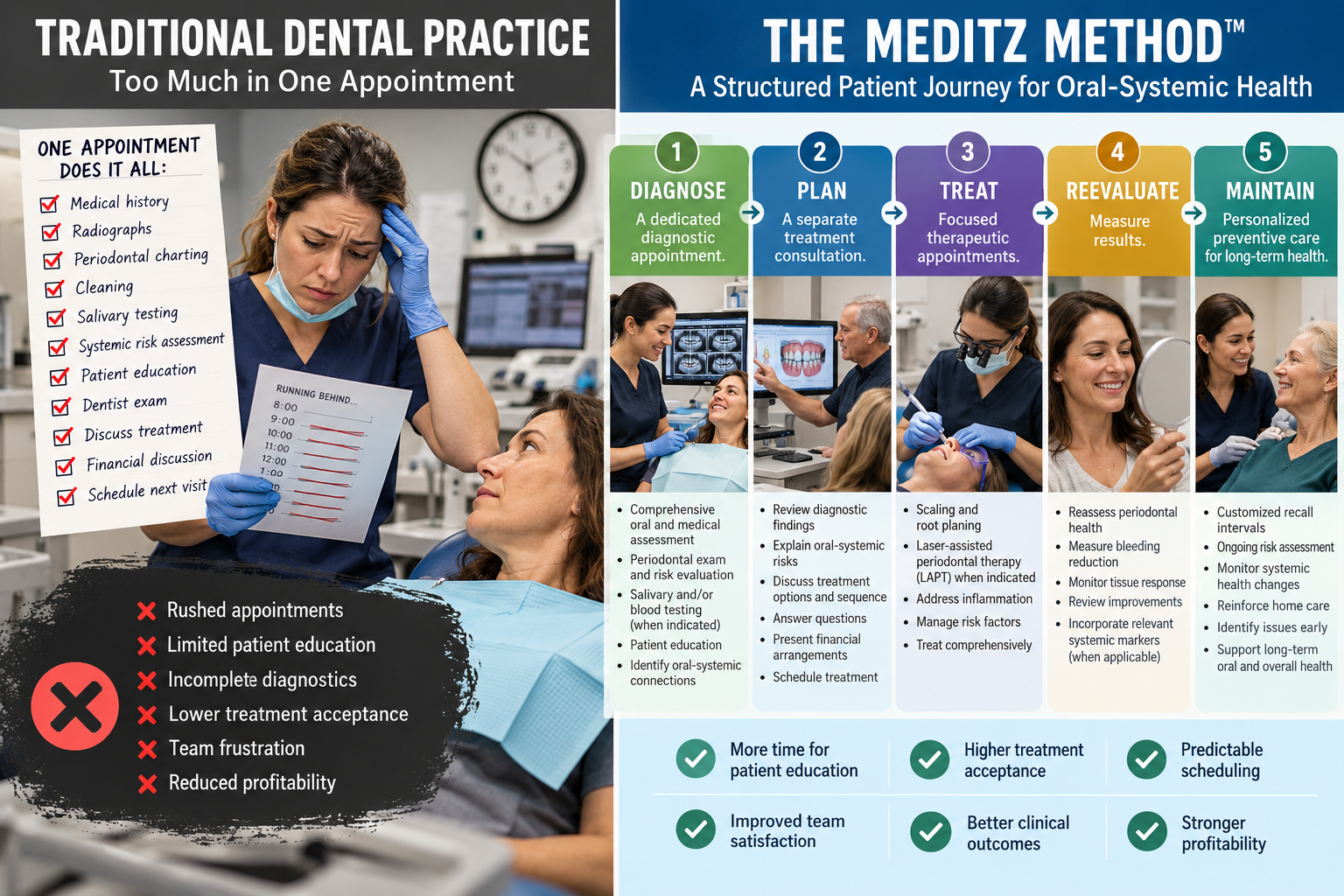
This Is the Heart of The Meditz Method™
At The Meditz Method™, we believe dentistry should move beyond simply repairing the damage disease leaves behind.
The goal is to recognize risk earlier.
That means asking more questions.
Why are the gums bleeding?
Why is bone being lost?
Why is periodontal disease recurring?
What is happening with the patient’s blood sugar?
Is systemic inflammation elevated?
Could smoking, medications, nutrition, sleep, cardiovascular health or another condition be influencing what we’re seeing?
And most importantly:
Who else on the healthcare team needs to know?
This is what medical-dental collaboration is supposed to look like.
Don’t Wait for Pain to Tell You Something Is Wrong
Heart disease can develop silently.
High blood pressure can develop silently.
Diabetes can develop silently.
Periodontal disease can develop silently.
And the biological processes associated with cognitive decline may begin years before obvious symptoms appear.
Your mouth cannot tell you that you are going to have a heart attack or develop dementia.
But it may give you information worth paying attention to.
Bleeding gums should not simply be dismissed as normal.
Progressive periodontal bone loss should not be viewed only as a problem of keeping your teeth.
Chronic inflammation deserves investigation wherever we find it.
Ask a Better Question at Your Next Dental Visit
Instead of asking only:
“Do I have any cavities?”
Ask:
“What is the health of my gums telling us about my overall health?”
Ask whether you have periodontal inflammation.
Ask whether bone loss is occurring.
Ask whether your periodontal condition has changed.
Ask whether any findings suggest that your physician should be involved.
And if you already have cardiovascular disease, diabetes, a history of stroke, cognitive concerns or significant periodontal disease, make sure both your medical and dental teams know about it.
The mouth is not an isolated collection of teeth.
It is the beginning of the digestive tract, connected to the bloodstream, influenced by the immune system and intimately connected with the rest of your biology.
Protecting your mouth may be about much more than saving your smile.
It may be one of the most overlooked pieces of protecting your health.
References
American Heart Association. Periodontal Disease and Atherosclerotic Cardiovascular Disease: A Scientific Statement. Circulation, 2025.
American Heart Association. Healthy Smiles, Healthy Hearts™.
Dibello V, et al. Impact of periodontal disease on cognitive disorders, dementia, and depression: a systematic review and meta-analysis. GeroScience, 2024.
Periodontitis, Tooth Loss, and Risk of Cognitive Impairment and Dementia: A Systematic Review With Meta-Analysis. 2026.
Periodontitis and Tooth Loss Are Associated With Higher Risks of Cognitive Disorders: A Systematic Umbrella Meta-Analysis.